The full operating cost of becoming an IB World School / Explainer
What does it cost to become an IB school? The invoice is the easy part
For an Indian school, a full Grade 1–12 IB journey is not one affiliation. It is usually three separate programme implementations—PYP, MYP and DP—with their own authorization, teacher-development, leadership, curriculum, resource and recurring operating costs.
If I already have the land, classrooms and the normal infrastructure needed to run a good school in India, what does it actually cost to make that school IB?
The answer begins with something that is easy to miss:
A Grade 1–12 IB school is not one programme. It is usually three.
The Primary Years Programme covers ages 3–12. The Middle Years Programme covers ages 11–16. The Diploma Programme covers ages 16–19.[1]
So a school that wants an IB journey from early years or Grade 1 through Grade 12 is usually budgeting for PYP + MYP + DP, each with its own authorization journey, coordinator, professional-development requirements and ongoing programme costs.
That is why the invoice is the easy part.
First separate the normal school cost from the IB cost
I would exclude the things the school needs anyway:
- land and building
- ordinary classrooms
- normal statutory approvals
- basic laboratories, library, sports and transport
- the core teacher payroll that would exist under another curriculum.
The real question is the incremental cost created by choosing IB.
For me, that cost sits in seven buckets:
1. IB application, candidacy and authorization fees. 2. Mandatory professional development. 3. Programme leadership. 4. Curriculum and policy redesign. 5. Programme-specific resources and staffing gaps. 6. Trial-implementation and cohort-ramp cost. 7. Recurring annual fees, assessment charges and retraining.
The IB itself effectively asks schools to think this way. Its sample DP authorization application asks for a five-year budget covering IB fees, workshops, travel, substitute teachers, personnel, resources, facilities and equipment.[2]
What each stage of school actually adds
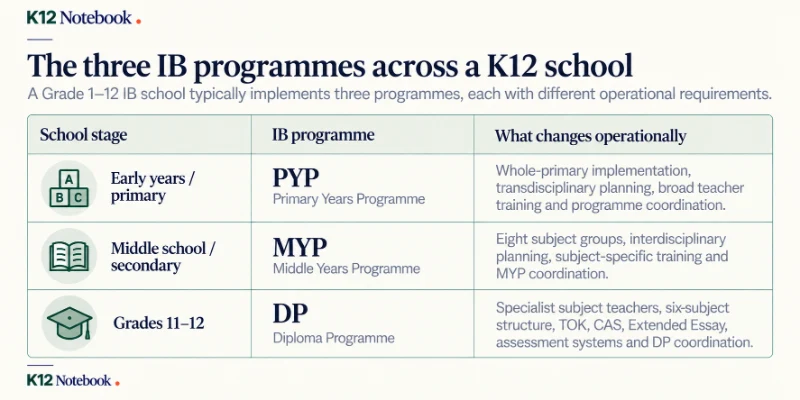
The PYP is for ages 3–12. Its current candidacy requirements say all students in the relevant primary division participate and that a school must offer at least two consecutive year levels.[3]
The MYP covers ages 11–16. The curriculum spans eight subject groups, with at least 50 teaching hours in each subject group in each year, subject to defined flexibility in the later years.[4]
The DP is structurally different again. Students complete six subjects plus the core: Theory of Knowledge, Creativity Activity Service and the Extended Essay.[5]
So even before talking about fees, a continuum school is making three different operating-model choices.
Teacher development is probably the first large visible bill
This is where the cost scales with the size of the school.
For authorization, the current IB requirements say:
- PYP: the pedagogical leadership team and all faculty working with PYP students, full- or part-time, complete the required Category 1 PYP workshop.
- MYP: all MYP teaching staff complete the introductory “Developing the MYP” workshop, and at least one teacher from each subject group completes a Category 1 subject workshop.
- DP: all DP subject teachers complete Category 1 subject training, while TOK, CAS and Extended Essay roles also have programme-specific training requirements.
- Every programme coordinator must complete the current “Leading the learning” Category 1 workshop.[6]
This is why school size matters.
IB’s public professional-development fee chart lists, for Asia-Pacific school-requested workshops, SGD 450 per participant for a standard two-day face-to-face workshop, SGD 380 for a requested online standard workshop and SGD 400 for a requested virtual standard workshop.[7]
Take a PYP division with 30 faculty members.
If all 30 require the standard school-requested face-to-face workshop, the published workshop-price arithmetic alone is:
30 × SGD 450 = SGD 13,500.
At 50 faculty, it becomes SGD 22,500.
That is before travel, accommodation where relevant, substitute cover, teacher time or any leadership workshop.
The point is not that every Indian school will pay exactly this amount. The school must confirm its assigned currency and current quote directly with IB. The point is that PYP training cost grows with the number of adults touching the programme.
MYP has a different shape. Every MYP teacher needs the introductory workshop, then at least one teacher per subject group needs subject-specific Category 1 training.[6] The public fee chart specifically provides one-day pricing for “Developing the MYP”, while the eight subject-group requirement creates another layer of training cost.[7]
DP becomes narrower but more specialised. The number of subjects the school chooses to offer changes how many teachers need Category 1 training. TOK, CAS, Extended Essay and the coordinator add further trained roles.[6]
So a modest full-continuum school can easily generate dozens of required training instances before authorization.
And training does not end at launch.
IB’s ongoing PD rules require new PYP teachers to participate in recognized IB professional development, maintain subject-group coverage in MYP, and train newly appointed DP subject teachers and core-role staff.[8]
Teacher turnover therefore becomes a recurring IB cost.
The next cost is leadership bandwidth
A school offering PYP, MYP and DP should not budget only for “one IB coordinator”.
Each programme has its own coordinator requirement.[6]
That may mean three distinct people in a large school, or overlapping roles in a smaller school where feasible. But the work still exists:
- programme planning
- teacher support
- evidence and documentation
- policy alignment
- curriculum review
- IB communication
- authorization and evaluation preparation.
Then DP adds named responsibilities around TOK, CAS and the Extended Essay.[5][6]
Some of those roles can be combined with teaching. Some become allowances rather than full-time positions.
But if the budget assumes the existing principal and teachers will simply absorb all of this “for free”, the school is probably understating the real cost.
Then come the resource gaps that are genuinely IB-specific
This is where I would resist generic statements like “IB schools need expensive infrastructure”.
Not necessarily.
A well-equipped Indian school may already have much of what it needs.
The correct question is incremental.
PYP may require more collaborative planning time, language provision and resources that support transdisciplinary inquiry.[3]
MYP’s eight-subject-group structure includes design, arts, physical and health education, sciences and language acquisition.[4] If the existing school does not already staff or resource those areas properly, the gap becomes an IB-conversion cost.
DP cost depends heavily on subject breadth.
A school offering Physics, Chemistry, Biology, Computer Science, Economics, Psychology, Visual Arts and multiple languages is carrying a very different specialist-teacher and resource base from a school offering a narrower portfolio.
The programme itself does not force one universal “IB lab budget”.
The school’s subject menu does.
That is why I would build the capex line subject by subject rather than put one round number called “IB infrastructure”.
Time itself costs money
PYP and MYP candidate schools must complete at least one academic year of trial programme implementation during candidacy.[6]
That matters financially.
The school may already be paying for:
- coordinator capacity
- teacher development
- new planning time
- resource upgrades
- consultant-visit logistics
- programme changes
before it has the full market benefit of being an authorized IB World School.
The candidacy fee is also annual during the relevant phase, and the authorization-services fee is billed annually from the point the school applies for authorization until authorization is granted.[9]
In Asia-Pacific, the school also bears specified hospitality and accommodation costs for consultant and verification visits.[10][11]
So delay has a cost.
A programme that takes an extra year to become authorization-ready does not just postpone the badge. It extends the period during which implementation costs are being carried.
After authorization, the cost does not disappear
The school then moves into steady-state IB economics.
That includes:
- annual programme fees
- student assessment charges where applicable
- recurring teacher development
- replacement training when staff leave
- coordinator and core-role payroll
- programme evaluation preparation
- continuing resource and curriculum updates.[9]
The IB says discounts are available for schools offering multiple programmes, but the public page does not publish an India-specific fee schedule.[9]
That is important.
I would not build an Indian investment case by converting the UK public fee table into rupees and calling it an India quote.
The school should obtain its current assigned-currency fee schedule directly from IB.
So what should an Indian founder actually budget?
I would build two separate budgets.
### Budget 1: Conversion / authorization
For each programme—PYP, MYP and DP—show:
IB invoice - application for candidacy - annual candidacy / consultation services - annual authorization-services fee - consultant and verification-visit logistics.
People - programme coordinator - required leadership roles - mandatory teacher workshops - substitute cover and teacher time.
Implementation - curriculum design - policy work - timetabling changes - incremental languages, design, arts, laboratory or library resources - programme-specific technology or assessment systems.
Ramp - cost carried during the trial and candidacy years - student cohort size when the programme launches - teacher utilisation before the programme fills.
### Budget 2: Recurring annual IB cost
Then separately show:
- annual school programme fee
- assessment / examination charges
- coordinator and role allowances
- ongoing PD
- retraining caused by staff turnover
- continuing resource upgrades.
That separation matters because a school can afford authorization and still build an unsustainable programme.
The number I would watch most carefully
It is tempting to obsess over the IB fee.
I would watch teacher utilisation and cohort size more closely.
A DP programme may need trained specialists and core-role leadership even when the first Grade 11 cohort is small.
A PYP implementation may require training almost the entire primary faculty.
MYP can require broad subject coverage before the secondary section is operating at mature enrolment.
So the real economic question is not:
“What is the IB affiliation fee?”
It is:
How much incremental fixed capability must I build before enough students are paying for it?
That is the cost of becoming an IB school that the invoice cannot show.
For an Indian operator planning a continuum from early years or Grade 1 through Grade 12, I would therefore treat IB as a multi-programme, multi-year operating investment.
The cheque to IB matters.
But the larger budget is people, preparation, subject breadth and the years required to make those costs productive.
The invoice is the easy part. The real investment is building a school that can deliver the programme with fidelity after the authorization team has left.
Show the working
Sources & calculations
Research checked 2026-10-06. Publication dates and reporting periods are listed separately.
- IB programmes ↗International Baccalaureate Organization · 2026-02-19
Current age ranges for PYP (3–12), MYP (11–16), DP (16–19) and the structure of the IB continuum.
Limit: Programme overview; it does not map ages precisely to Indian grade labels. - Sample Application for authorization — Diploma Programme ↗International Baccalaureate Organization · 2022
Five-year budget structure covering IB fees, professional development, workshops, travel, substitute teachers, resources, facilities/equipment and personnel.
Limit: Sample DP application, not an India cost benchmark. - Overview of requirements for candidacy — PYP ↗International Baccalaureate Organization · 2025-11
PYP age/structure requirements, whole-primary participation, at least two consecutive year levels, programme coordinator, budget and language requirements.
Limit: Requirements document; it does not state India-specific implementation costs. - MYP curriculum ↗International Baccalaureate Organization · 2026-02-19
Eight MYP subject groups and minimum 50 hours of teaching time per subject group per year, subject to later-year flexibility.
Limit: Programme framework, not a staffing or facility prescription. - Diploma Programme ↗International Baccalaureate Organization · 2026-02-19
DP age range and six-subject structure plus TOK, CAS and Extended Essay core.
Limit: Programme overview; actual school subject breadth varies. - Candidacy — professional development requirements ↗International Baccalaureate Organization · 2026-02-19
Current authorization PD requirements for coordinators, PYP faculty, MYP teaching staff/subject groups and DP subject/core roles; PYP and MYP one-academic-year trial implementation milestone.
Limit: Does not publish India-specific workshop invoices. - IB global professional development fees chart ↗International Baccalaureate Organization · Current public chart accessed 2026
Public Asia-Pacific workshop-price architecture including SGD 450 per participant for requested standard face-to-face workshops, SGD 380 requested online and SGD 400 requested virtual; one-day pricing for Developing the MYP/CP.
Limit: Public global fee chart carries older copyright text and is not an India-specific quote. Schools should confirm current applicable pricing and assigned currency directly with IB. - Meeting professional development requirements ↗International Baccalaureate Organization · 2026-02-19
Ongoing PD expectations after authorization, including new PYP teachers, MYP subject-group coverage and newly appointed DP subject/core staff.
Limit: Does not quantify staff turnover or school-specific annual PD budgets. - Fees and services ↗International Baccalaureate Organization · 2026-02-19
Application, candidacy, consultation, authorization, annual programme and assessment fee architecture and multi-programme annual-fee discounts.
Limit: Public page does not state India-specific fee amounts; assigned currency and current invoices must be confirmed with IB. - Consultation ↗International Baccalaureate Organization · 2026-02-19
Consultant support and Asia-Pacific school responsibility for consultant accommodation and local hospitality/transport during the consultation visit.
Limit: Actual visit cost depends on location and arrangements. - Verification visit ↗International Baccalaureate Organization · 2026-02-19
Two-day verification process and Asia-Pacific school responsibility for visiting-team accommodation, local transportation and meals.
Limit: Actual visit cost depends on team, city and travel arrangement.
What this does not establish: IB does not publish a current India-specific public fee schedule on the pages reviewed, so this article does not invent a total rupee cost. Public Asia-Pacific workshop prices are used only to illustrate how mandatory PD scales with staff count and must be reconfirmed with IB. Normal land/building and baseline school costs are deliberately excluded. Actual incremental cost depends heavily on school size, existing staff capability, programme combination, subject breadth, candidacy duration, delivery mode, teacher turnover and cohort ramp.