School-group structure
Is it a Second Campus or a School Group?
Opening another campus makes a school brand name bigger. The harder question is whether the next school inherits useful capability without making responsibility harder to follow. Is it a group...
Suppose your first school is working well. How do you open the next one without starting all over again?
Find another site. Build classrooms. Recruit teachers. Put the same name on the gate.
You now have a second campus. But do you have a school group?
For me, the answer depends on one thing: does the next school inherit useful capability, or only a familiar name?
That is why the structure behind a school matters. Not because founders need complicated corporate charts, but because property, capital, shared educational capability and school operation are different jobs.
Four jobs behind one school
A useful way to think about a school group is: - Someone needs to own the land or the building on which the school runs - Someone needs to bring in the capabilities, curriculum, know-how, and expertise - Someone needs to run the school within the state regulatory framework - and lastly someone needs to bring in the investment for all this
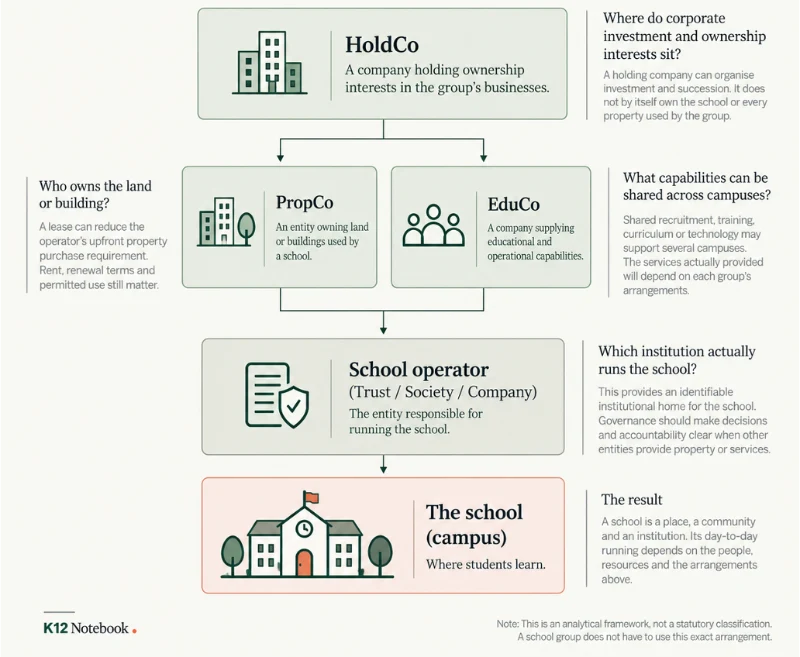
A school group does not need four separate entities. The point is that owning a building, investing capital, supporting several campuses and running a school are not the same responsibility.[1][3][5]
And this really matters when you reach campus two, three or ten. Buying every property outright can absorb capital before the school has enrolled a child. Leasing can reduce that upfront purchase requirement, although rent and long-term access still matter. A teacher-induction programme might be designed once and used across several campuses. Recruitment, curriculum support or technology may also be shared.
That is where a group begins to make sense: reuse what genuinely travels while keeping enough capability inside each school.
Think of it from financing perspective too. A PropCo getting rental yield on property should find it easy to raise debt or patient capital to acquire more properties and grow. While a EduCo which is asset light may find it easier to raise strategic or VC or short-term funds to expand the reach of its capabilities.
Heritage in Gurugram gives us a real example
Thanks to records around Heritage Xperiential Learning School in Sector 64, Gurugram, being publicly available to the tune we can make out the structure but not to the level that we know how things move between these entities.
The school land certificate identifies Core Properties LLP as owner of a 19,259.63 sq m site—about 4.76 acres—and Lala Sher Singh Memorial Jeevan Vigyan Trust as the lessee running the school. The recorded lease runs from 1 April 2025 to 31 March 2055, or 30 years.[1]
Separately, Lighthouse Learning records its acquisition of the Heritage Group in 2023, and CRISIL later includes the operating trust within its Lighthouse group analysis.[3][5]
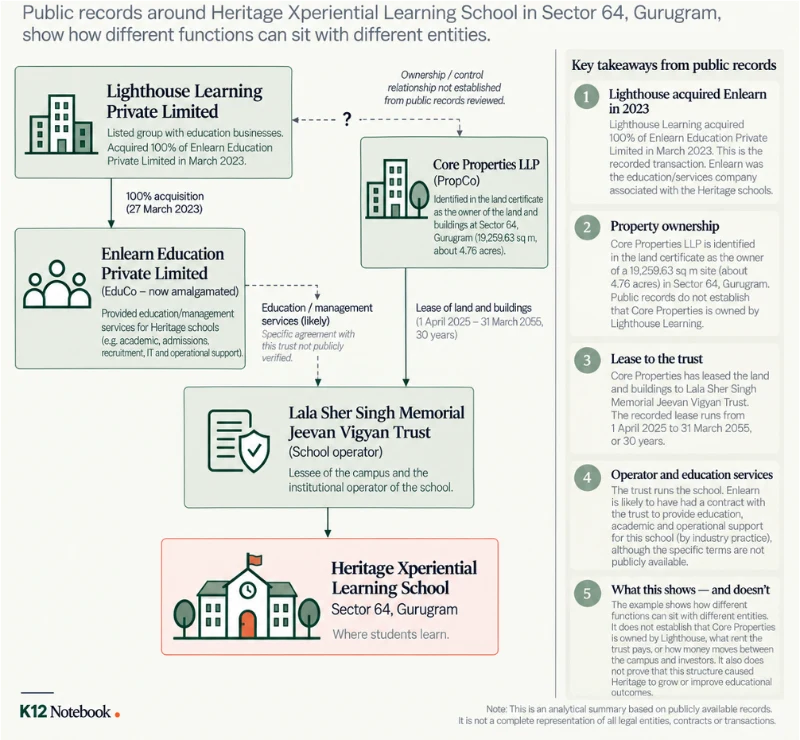
That is useful evidence of different layers. It does not establish that Core Properties is owned by Lighthouse, what rent the school pays, or how money moves between the campus and investors.
The example helps explain structure. It does not prove that this structure caused Heritage to grow or improve educational outcomes.
So what can go wrong?
More entities can also create more confusion.
Imagine a classroom needs an urgent repair. Is that the landlord’s responsibility, the school’s or a central services company’s? If nobody can answer quickly, the structure has failed the school.
The same applies to shared services. A central team can support several campuses, but teacher coaching, leadership and parent issues still need people who know the individual school. Centralisation is useful only until it becomes distance.
Interestingly, Lighthouse’s own corporate history provides the counterpoint. Enlearn Education had provided management, admissions, recruitment and IT services. It was later amalgamated into Lighthouse; the stated rationale included reducing duplication and simplifying corporate processes.[4][5]
So I would not judge a school group by how many boxes are on its organisation chart.
I would judge it by whether the next campus is easier to build, easier to support and still easy to hold accountable.
A second campus makes you bigger. A structure that lets capability travel without letting responsibility disappear is what begins to make you a group.
Show the working
Sources & calculations
Research checked 2026-10-03. Publication dates and reporting periods are listed separately.
- Sector 64 land certificate — brief transcription ↗Heritage Xperiential Learning School · Issue date unverified
Brief pp.3–4: Core Properties LLP, formerly Pvt. Ltd.; trust lessee/operator; 19,259.63 sq m; lease 1 April 2025–31 March 2055.
Limit: PDF retrieval failed. Details are supplied-brief evidence, not a fresh certificate audit. Full lease, present title and landlord ownership remain unverified. - Lighthouse Learning — Our Journey ↗Lighthouse Learning · Undated; event 2023
Group history records the Heritage Group acquisition under 2023.
Limit: Provider account, not evidence of land ownership or every campus contract. - NCLT: Enlearn and Lighthouse, CAA 76/2024 ↗NCLT Mumbai · 2024-05-21
PDF pp.2–4: entire-stake acquisition on 27 March 2023; Enlearn services; applicants' proposed merger rationale.
Limit: Parsed PDF checked; screenshots failed. Procedural order, not final merger sanction. Expected benefits are not measured results. - Mothers Pet Education Society rating rationale ↗CRISIL Ratings · 2025-09-30
Includes operating trust in Lighthouse group analysis; operational/financial links and common management; reports Enlearn amalgamated into Lighthouse.
Limit: Indexed official text checked after HTTP 406. Ratings grouping is not legal ownership of a trust. No current cap table inferred.
What this does not establish: Private draft. The Heritage example remains bounded to documented relationships. The site area and lease term appear only within the Heritage passage rather than as headline metrics. The land-certificate details were transcribed from the supplied brief because the linked PDF was not independently retrievable in the prior source check. No claim about rent, money flows, property-owner beneficial ownership, tax treatment or causal growth/education benefits. No CMS image asset is currently attached to this article; the compact framework table remains in the body until the owner uploads the final visual.